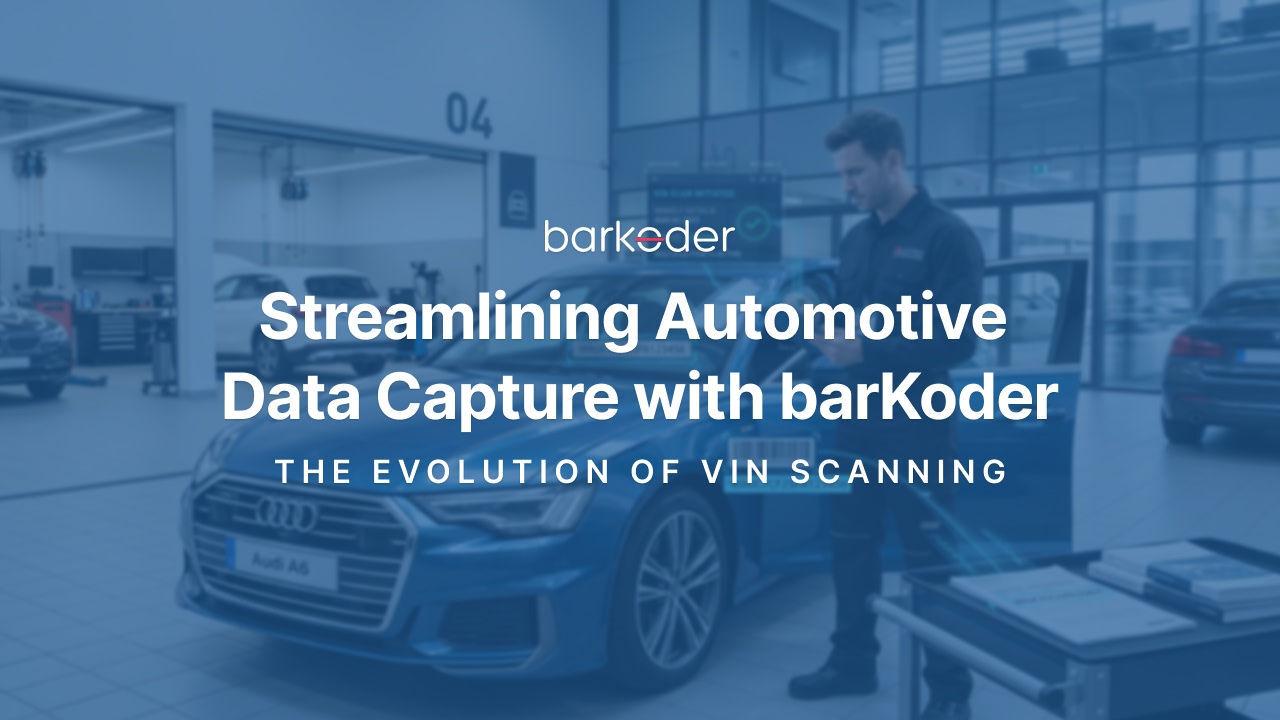
In the automotive, logistics, and insurance sectors, accuracy isn't just an asset - it's a regulatory and operational requirement. At the center of this ecosystem lies the Vehicle Identification Number (VIN). A 17-character alphanumeric fingerprint, the VIN communicates critical data about a vehicle’s manufacturer, build year, engine type, and production sequence.
Capturing this data quickly and flawlessly is paramount for fleet management, roadside inspections, vehicle shipping, and salvage yards. However, traditional workflows have long been plagued by operational friction. Manual typing leads to costly human errors, while standard hardware scanners struggle under real-world conditions.
With the emergence of enterprise-grade software solutions like the barKoder Barcode Scanner SDK, businesses are transitioning away from bulky physical hardware. By integrating an intelligent VIN scanning engine directly into mobile or web-based applications, organizations can transform standard smart device cameras into powerful, industrial data-capture tools.
The Complexity of the VIN Landscape: Barcodes vs. Text
One of the biggest hurdles in vehicle data acquisition is that VINs do not present themselves in a single uniform format. Depending on the automotive manufacturer, the model year, and the location on the vehicle (e.g., the door jamb sticker, dashboard plate, or vehicle documentation), a VIN may appear as a barcode or as flat text.
Traditional VIN Barcodes
Historically, the automotive industry has relied heavily on linear 1D barcodes to encode vehicle identifiers. The most common among these is Code 39 due to its native alphanumeric compatibility. To support higher data security and density in tighter spaces, many modern setups utilize Code 128 barcodes. In recent years, 2D matrix styles such as QR Codes and Data Matrix formats have also seen a rise in vehicle tracking scenarios.
The Rise of VIN OCR (Optical Character Recognition)
Barcodes are highly effective, but they aren't always present or readable. If a vehicle label is scratched away, or if a technician needs to pull the VIN directly from the stamped metal chassis or a printed paper invoice, a barcode reader alone won't suffice.
To bridge this gap, barKoder has introduced its advanced VIN OCR Capture Capability. This technology allows the software engine to visually detect the alphanumeric text, instantly recognize and validate the 17-character pattern, and extract the text cleanly using a standard smartphone or tablet camera. No barcode required, no guesswork, and zero manual typing.
Overcoming Real-World Challenges with Proprietary barKoder Core Tech
Automotive environments are notorious for harsh scanning conditions. Vehicles parked outdoors are subject to heavy glare, shadows, dirt, and water. Labels placed behind curved windshields or taped to car windows become warped, scratched, or blurred.
Standard open-source scanning libraries fail almost immediately when confronted with these environmental obstacles. The barKoder engine is purposely architected to thrive in these conditions by deploying our proprietary software innovations:
1. Defeating Wrinkles and Curved Glass with Segment Decoding®
When linear barcodes like Code 39 or Code 128 are printed on flexible inventory stickers or viewed through angled glass, they suffer from severe distortion along the Z-axis. Traditional lasers require a perfect, straight line to slice across every bar simultaneously. Our breakthrough Segment Decoding technology overcomes this limitation by locating and mathematically reconstructing fragments of the deformed code, ensuring a successful read even at extreme angles.
2. Revitalizing Damaged 2D Matrix Codes with MatrixSight®
For newer vehicles employing high-density QR or Data Matrix labels, physical wear and tear can completely compromise the data matrix pattern. Our flagship MatrixSight algorithm goes beyond conventional decoding constraints to salvage, interpret, and successfully parse incomplete or heavily obscured 2D barcodes that hardware scanners reject.
3. Cleaning Up Camera Motion via DeBlur Mode
In fast-paced logistics hubs or car auctions, technicians move rapidly from vehicle to vehicle. This constant movement leads to lens or motion blur. barKoder integrates a dedicated DeBlur Mode that dynamically enhances image resolution and contrast in real time, pulling crisp data out of low-resolution camera feeds before processing.
How Cross-Platform Integration Empowers Automotive Workflows
Enterprise operations utilize a diverse array of technical infrastructures. Whether your team relies on rugged field tablets, consumer-grade smartphones, or internal desktop kiosks, barKoder provides broad, frictionless support across the entire software development spectrum.
Our core engine can be integrated natively across iOS and Android mobile ecosystems, as well as cross-platform frameworks like Flutter, React Native, .NET MAUI, and Capacitor.
Furthermore, our Web Barcode Scanner SDK (WASM) changes the game for cloud-based logistics portals. By taking advantage of WebAssembly, automotive web applications can tap directly into the device's camera inside modern browsers like Chrome, Edge, or Safari, offering desktop or laptop-based VIN scanner performance without requiring heavy external client software installations.
Targeted Solutions for Automotive and Asset Logistics Industries
Implementing a specialized VIN scanning solution unlocks immediate ROI across multiple verticals within our global Industries Solutions matrix:
- Automotive Inspection & Salvage: Vehicle inspectors and roadside assistance teams must log data rapidly under tight deadlines. Automating text and barcode capture via barKoder VIN Scanning cuts average vehicle check-in times down from minutes to mere seconds.
- Warehousing & Finished Vehicle Logistics: Managing rows of thousands of incoming cars at shipping ports requires intense data integrity. Combining multi-barcode parsing with our Batch MultiScan tool allows logistics operators to track multiple shipping labels, inventory tags, and VIN stickers from a single camera viewpoint.
- Identity and Document Matching: In vehicle rental and leasing offices, processing a car transaction requires validating both the vehicle asset and the driver. Along with enterprise vehicle scanning, the SDK serves as an elite MRZ Scanner, letting staff scan the Machine Readable Zone of passports, visas, and driver’s licenses on the exact same app interface.
Real-World Use Cases: BarKoder in Action
To understand the tangible impact of these capabilities, look no further than how industry leaders are currently leveraging BarKoder’s technology to optimize their operations:
1. Streamlining Automotive Roadside Assistance: The Club Assist Case Study
In the demanding field of roadside assistance, speed and accuracy are critical. Club Assist, a mobile automotive solution provider, integrated BarKoder to revolutionize how technicians handle car battery replacements and inventory management. The Challenge: Technicians frequently operate in low-light environments, tight engine bays, and harsh weather conditions, making it difficult to scan battery serial numbers and barcodes. The Solution: By embedding the BarKoder SDK into their mobile applications, Club Assist enabled technicians to instantly capture vehicle identification numbers (VINs) and battery barcodes on the spot. Even when barcodes are dirty, damaged, or obscured, BarKoder ensures a seamless scan, significantly reducing manual data entry errors and minimizing the time spent per service call. Read the full story: Club Assist Success Story.
2. Accelerating Vehicle Logistics: The eCarMover Case Study
For automotive logistics providers, tracking vehicles across vast transit networks requires flawless data capture. eCarMover, a premier vehicle transport logistics company, turned to BarKoder to enhance their digital tracking ecosystem. The Challenge: Drivers and yard managers need to scan VIN barcodes through windshields, often facing issues with glare, reflection, distortion, or physical damage to the barcode labels. The Solution: BarKoder’s advanced matrix and linear scanning capabilities allowed eCarMover to drastically improve their VIN scanning success rate. Drivers can now scan barcodes effortlessly under direct sunlight or through distorted glass surfaces using standard smartphones. This integration has accelerated loading and unloading times, improved inventory visibility, and automated the chain of custody tracking. Read the full story: eCarMover Success Story.
Scan Smarter, Not Harder: Why Enterprises Trust barKoder
At barKoder, our core focus is engineering the world’s most accurate, developer-friendly software data capture mechanisms. We pride ourselves on creating high-performance algorithms that replace the need for specialized, fragile handheld scanning devices. To read more about our background and mission to optimize global scanning, visit About barKoder.
Are you ready to optimize your automotive or fleet tracking application with the market's leading vehicle identifier decoding technology? Review our transparent Enterprise & Consumer Pricing Packages to find an enterprise tier perfectly aligned with your company’s architecture.
Don't let manual entry or low-performing scan modules create bottlenecks in your operations. Get started today - download your free 30-day trial license and see the barKoder difference firsthand!