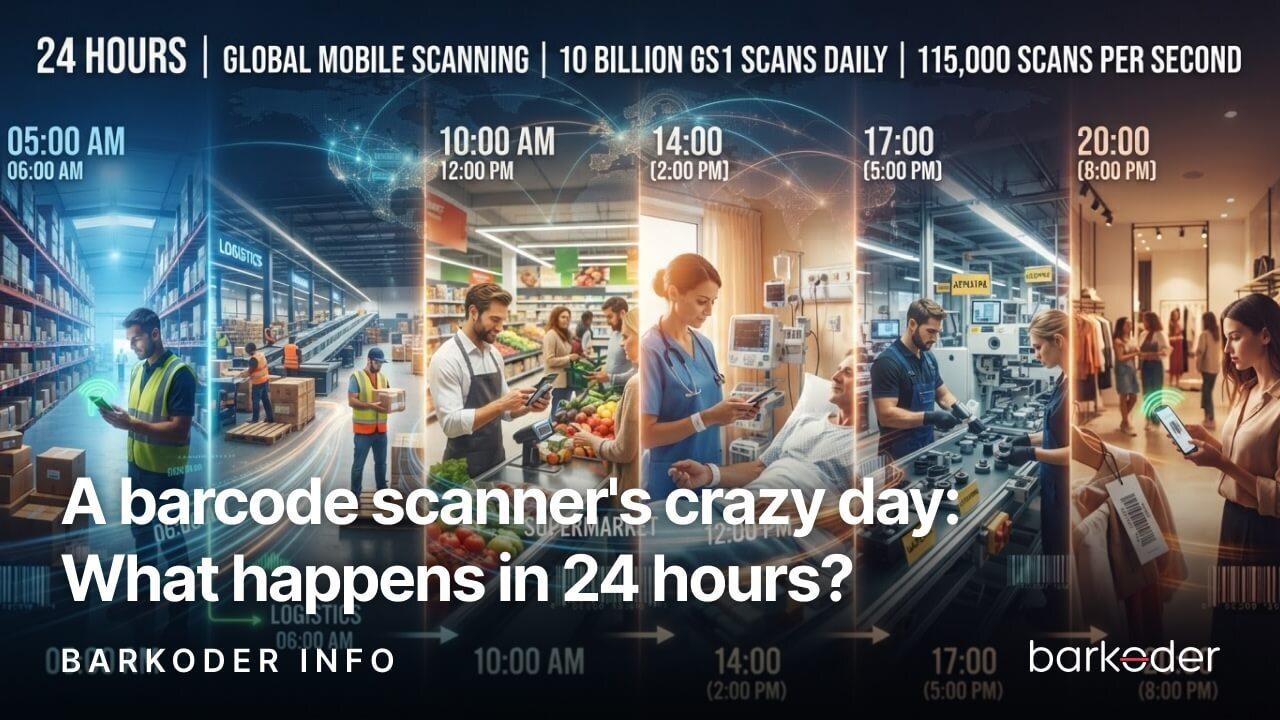
Intro: The Beep That Never Sleeps
You wake up.
You make coffee.
Somewhere, a barcode has already been scanned thousands of times.
By the time you finish reading this paragraph, products have been scanned in supermarkets, packages have moved through warehouses, medicines have been identified, and inventory systems have been updated.
The barcode scanner never really sleeps.
With more than 10 billion barcode scans happening every day, that is an average of roughly:
- 416.7 million scans per hour
- 6.94 million scans per minute
- 115,700 scans per second
Those calculations make one thing very clear:
Somewhere in the world, thousands of barcodes are being scanned every second.
The barcode might look simple, but its daily life is absolutely crazy.
00:00 - Midnight: The World Is Still Scanning
While most people are asleep, global commerce is still awake.
Warehouses are receiving shipments. Distribution centres are sorting packages. Inventory systems are being updated.
A barcode scanned at midnight might be attached to:
A package travelling across a country
A medical product being tracked
Inventory being counted
A shipment being loaded onto a truck
And remember: barcode scanning happens across supply chains and industries in countries around the world, not just at supermarket checkouts. GS1 standards are used by millions of companies globally.
06:00 - Good Morning, Warehouse!
The morning shift begins.
Suddenly, the barcode scanner has work to do.
Products arrive.
Boxes are opened.
Packages are sorted.
Inventory is counted.
Every successful scan connects a physical object with digital information.
That is one of the reasons barcodes became such an important part of modern commerce: the same product identity can move through manufacturing, logistics, warehouses, stores, and digital systems.
And the scale is enormous. GS1 standards support more than 2 million companies and are used across numerous industries and countries.
09:00 - Supermarket Chaos Begins
Now things get loud.
Beep.
Milk.
Beep.
Bread.
Beep.
Bananas.
Beep.
A product that probably did not need another barcode sticker.
Retail is where many people first think about barcode scanning, but the barcode is doing much more than simply showing a price.
It connects products with inventory systems and product information.
And with more than 10 billion scans happening daily, those familiar checkout beeps are only part of a much larger global story.
12:00 - Lunch Break? Not for Barcodes
Humans take lunch breaks.
Barcodes don't.
At this point in the day, scanners are still working across:
- Food and grocery
- Logistics
- Apparel
- Healthcare
- Automotive
- Manufacturing
GS1 standards support supply chains across more than 25 industries, showing just how far barcode technology has moved beyond the supermarket checkout.
15:00 - Healthcare: Where Every Scan Can Matter
Now our imaginary barcode scanner enters a completely different world.
Here, a barcode may help identify:
- Medical products
- Specimens
- Equipment
- Medication
- Healthcare-related inventory
Barcode technology has become an important part of identification and traceability in healthcare. GS1 reports that GS1 DataMatrix is already used in healthcare in more than 70 countries.
Research has also found significant reductions in certain specimen-identification errors after barcode implementation, demonstrating why reliable barcode capture can matter far beyond retail.
In some environments, a barcode scan is not just about speed. It is about accuracy and traceability.
18:00 - The Evening Shopping Rush
People are leaving work.
Supermarkets become busy again.
Shopping centres fill up.
Online orders are being prepared.
Packages are scanned before shipping.
Products are scanned at checkout.
And somewhere, someone is holding up the entire line because the barcode scanner refuses to scan one damaged barcode.
Every scanner has had a day like that.
This is also where scanning technology matters. In the real world, barcodes are not always perfect.
They can be:
- Blurry
- Damaged
- Small
- Curved
- Poorly printed
- Reflected by shiny packaging
- Viewed in difficult lighting conditions
A barcode scanner's day would be much easier if every barcode looked perfect.
Unfortunately, reality has other plans.
21:00 - The Barcode Is Changing
For decades, traditional 1D barcodes have been the familiar face of product identification.
But the barcode scanner's job is becoming more interesting.
The industry is moving toward 2D barcodes, including QR Codes powered by GS1 and GS1 DataMatrix.
These codes can provide access to much richer information than traditional product identifiers, including information related to product usage, recycling, safety, and other consumer-facing data.
The global retail industry is working toward the ability to scan next-generation 2D barcodes at points of sale by the end of 2027.
For barcode scanners, the future is clearly not becoming less busy.
23:59 - One More Beep Before Tomorrow
The day is almost over.
But before midnight arrives, let's look at the numbers one more time.
A Barcode Scanner's Crazy Day in Numbers
In 24 hours:
10,000,000,000+ scans
In 1 hour:
416,000,000+ scans
In 1 minute:
6,900,000+ scans
In 1 second:
115,000+ scans
All based on the widely cited figure of more than 10 billion GS1 barcode scans per day.
And then...
Beep.
A new day begins.
The Barcode Scanner Never Sleeps
From supermarkets and warehouses to hospitals and supply chains, barcode scanning has become one of the invisible technologies powering modern life.
Most people don't think about barcode scanning.
They only hear:
Beep.
But behind that beep can be a product identity, an inventory update, a logistics event, a traceability record or the start of an entirely new customer experience.
With billions of scans happening every day and the transition toward next-generation 2D barcodes accelerating, the next 24 hours for barcode scanners could be even crazier.
And that is where fast, reliable barcode scanning technology becomes essential.
Ready to Build Your Own Barcode Scanner?
Whether your application scans products, packages, QR codes, Data Matrix codes, ID documents, or other barcode types, barKoder SDK is designed to bring fast and reliable barcode scanning to mobile and web applications.
Because somewhere right now...
another barcode needs to be scanned.