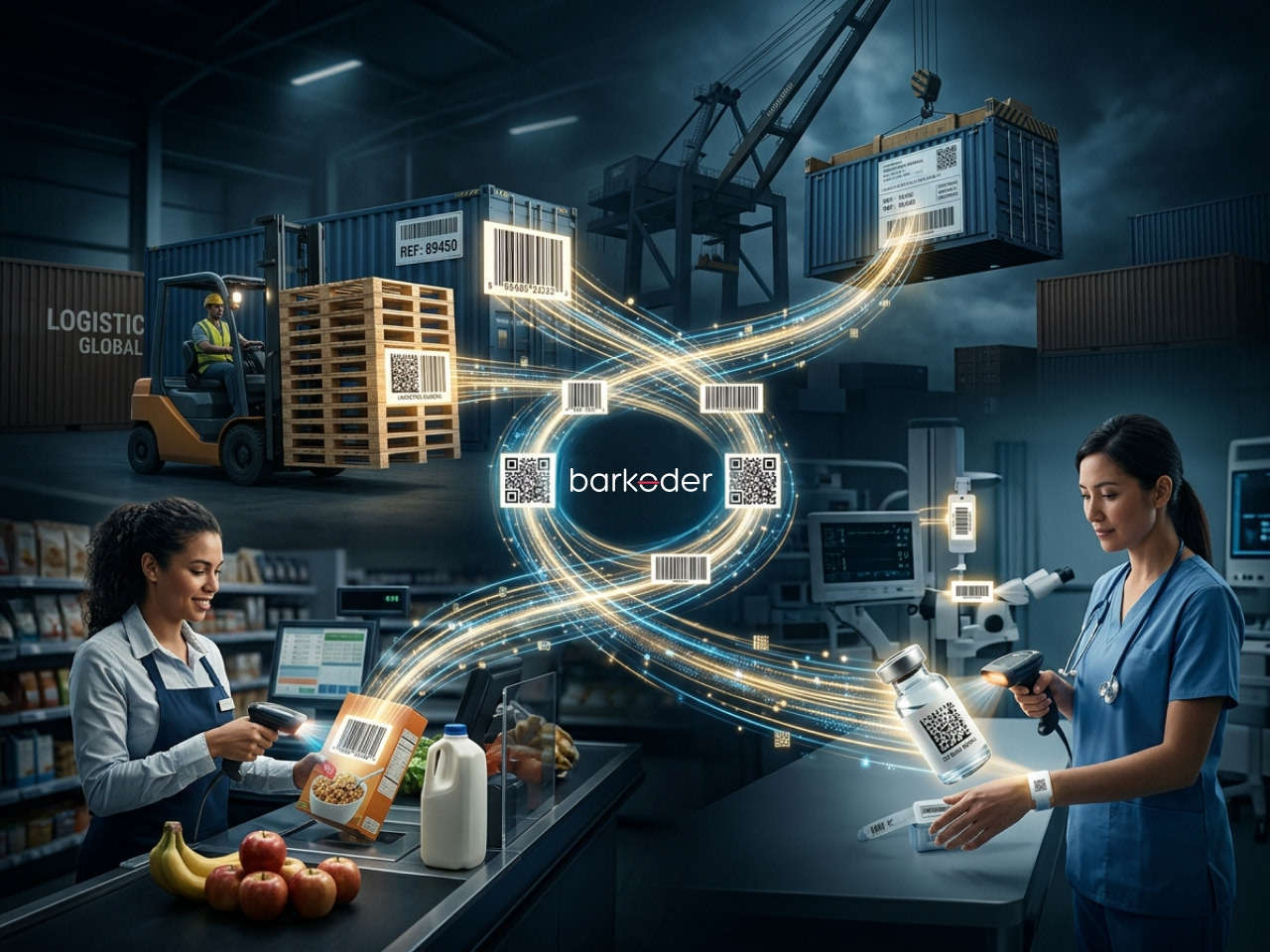
From the grocery store checkout line to complex industrial supply chains, barcodes are the invisible threads holding modern commerce together. But not all barcodes are created equal. Depending on your industry, data needs, and scanning environment, the type of barcode you choose can drastically impact your operational efficiency.
Whether you are managing retail inventory, tracking medical equipment, or routing logistics, understanding the different types of barcodes is essential.
In this comprehensive guide, we will break down the two main categories of barcodes - 1D (linear) and 2D (matrix) - explore their common variants, and help you determine which is right for your business.
The Two Main Categories: 1D vs. 2D Barcodes
At the highest level, barcodes are divided into two primary categories based on how they store and display data. For a deeper look into how they contrast in real-world workflows, see our analysis on 1D vs 2D Barcodes.
1. One-Dimensional (1D) Barcodes
Also known as linear barcodes, 1D barcodes represent data by varying the widths and spacings of parallel lines. They typically hold a limited amount of data (usually 20–25 characters) and act as a key or index to look up information in a central database.
- Best for: Basic retail checkout, simple inventory tracking, and closed-loop systems.
2. Two-Dimensional (2D) Barcodes
2D barcodes organize data using two-dimensional geometric patterns like squares, dots, and hexagons. Because they encode data both horizontally and vertically, they can hold thousands of characters - including text, website URLs, and binary data - within a tiny footprint. They can even function without an internet connection because the data is stored directly inside the code itself.
- Best for: Mobile scanning, marketing, complex logistics, and industries with strict space constraints (like healthcare).
Common Types of 1D Barcodes
UPC & EAN (Universal Product Code & European Article Number)
If you have ever bought a consumer good, you have seen a UPC barcode. Standardized primarily for retail in North America, UPC-A encodes 12 digits consisting of a manufacturer identification number and an item number. EAN codes are the international counterparts to UPC codes. The most common version, EAN-13, contains 13 digits and is used across Europe, Asia, and the rest of the world for retail products.
- Primary Use Case: Global retail point-of-sale (POS). Learn more on the EAN/UPC Code reference hub.
Code 128
Code 128 is a highly dense, alphanumeric barcode capable of encoding all 128 characters of the ASCII character set. It is widely adopted in non-retail industries due to its ability to pack extensive text and numeric information into a compact format.
- Primary Use Case: Logistics, shipping container labels, and supply chain management. Learn more about Code 128.
Code 39
One of the oldest and most widely used barcodes, Code 39 is alphanumeric and can be read by almost any barcode scanner. While reliable, it takes up significantly more physical space than Code 128 to store the same amount of data.
- Primary Use Case: Automotive manufacturing (such as VIN tracking), defense, and electronics tracking. Learn more about Code 39.
Other Notable 1D Subtypes
- Codabar: Frequently utilized for logistics tracking, airbills, and blood bank management.
- Code 11: Mainly utilized for telecom equipment labeling.
- MSI Plessey: A legacy barcode standard optimized for marking warehouse shelves and storage containers.
(Discover specifications for all these variants on the barKoder Symbologies Page.)
Common Types of 2D Barcodes
QR Code (Quick Response Code)
The QR code is arguably the most recognizable 2D barcode globally. Initially developed for tracking automotive parts, its high fault tolerance and fast readability have made it the go-to barcode for consumer engagement. QR codes can be easily scanned by standard smartphone cameras.
- Primary Use Case: Marketing, mobile payments, digital ticketing, and website redirects. Learn more about QR Code features.
Data Matrix
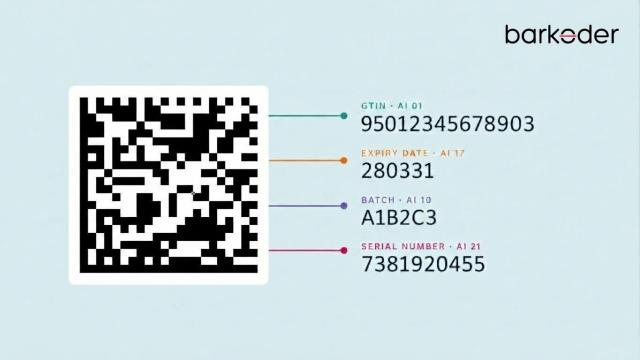
Data Matrix codes look similar to QR codes but offer even higher data density within a microscopic square or rectangular footprint. They feature high redundancy, meaning they remain readable even if partially damaged or scratched, making them the ultimate standard for industrial track-and-trace.
- Primary Use Case: Aerospace manufacturing, defense, and marking small electronics or surgical instruments. Explore our dedicated Data Matrix scanner SDK insights.
PDF417
Unlike other 2D barcodes, PDF417 is a stacked linear barcode. It can store immense amounts of data - up to 1.1 kilobytes - making it essentially a portable data file. It is the standard barcode format used for official government identification.
- Primary Use Case: Driver's licenses, boarding passes, and postage labels. Learn more about PDF417.
Aztec Code
Recognizable by the distinct "bullseye" finder pattern in its center, the Aztec code is designed to occupy less space than QR codes because it doesn't require a surrounding "quiet zone" (blank space). It is highly efficient for scanning on digital screens.
- Primary Use Case: Transport ticketing (trains, airlines) and transit systems. Learn more about Aztec Code.
MaxiCode
MaxiCode is a specialized 2D matrix barcode created by UPS to streamline package tracking and sorting at high speeds on fast-moving conveyor belts.
- Primary Use Case: Automated routing and parcel delivery. Explore our guide on MaxiCode Barcode scanning.
How to Choose the Right Type of Barcode
Selecting the right barcode depends entirely on your operational constraints. Ask yourself the following questions:
- How much data do you need to store? If you only need to store a 12-digit product ID, a 1D barcode like UPC or Code 128 is perfect. If you need to embed an entire URL, serial number, or batch history, look into 2D barcodes.
- How much physical space is available? For tiny components or medical vials, a Data Matrix code packs the most data into the smallest millimeter-wide space.
- What scanning hardware will be used? Standard laser scanners can only read 1D barcodes. If your operations rely on smartphone scanning, camera-based vision systems, or mobile apps, 2D barcodes are highly optimized for image-based scanning. Keep in mind that global systems are shifting rapidly ahead of the GS1 Sunrise 2027 transition to 2D codes at point-of-sale.
Powering Your Barcode Strategy with barKoder
No matter which types of barcodes your business relies on, your scanning software needs to be fast, accurate, and resilient.
The barKoder Barcode Scanner SDK transforms any smartphone, tablet, or enterprise device into an enterprise-grade barcode scanning powerhouse. Supporting a vast library of 1D and 2D barcodes - powered by advanced proprietary algorithms like MatrixSight® for decoding heavily damaged 2D patterns - barKoder ensures your team captures data flawlessly on the first try.
Ready to elevate your barcode workflow? Explore our Barcode SDK Features or sign up for a free trial.