Scanning a barcode is easy when there’s only one barcode in view.
But real-world environments rarely work that way.
Point a camera at a warehouse shelf and you might see dozens of barcodes. Scan a retail display and multiple products can appear at once. Look at a shipping pallet, document, vehicle, or piece of equipment, and there may be several codes competing for attention.
The problem is no longer “Can I scan a barcode?”
It becomes:
“Can I find the exact barcode I’m looking for?” That’s where barKoder Search & Find comes in.
Search & Find introduces a smarter, more interactive approach to barcode scanning. Instead of accepting the first valid barcode detected by the camera, developers can tell barKoder exactly what result they are looking for—and let the scanner continuously search the camera view until it finds it.
When detecting a barcode isn’t enough
Traditional barcode scanning is designed around a simple workflow: point the camera at a barcode, detect it, decode it, and return the result.
That works perfectly when there is only one relevant barcode.
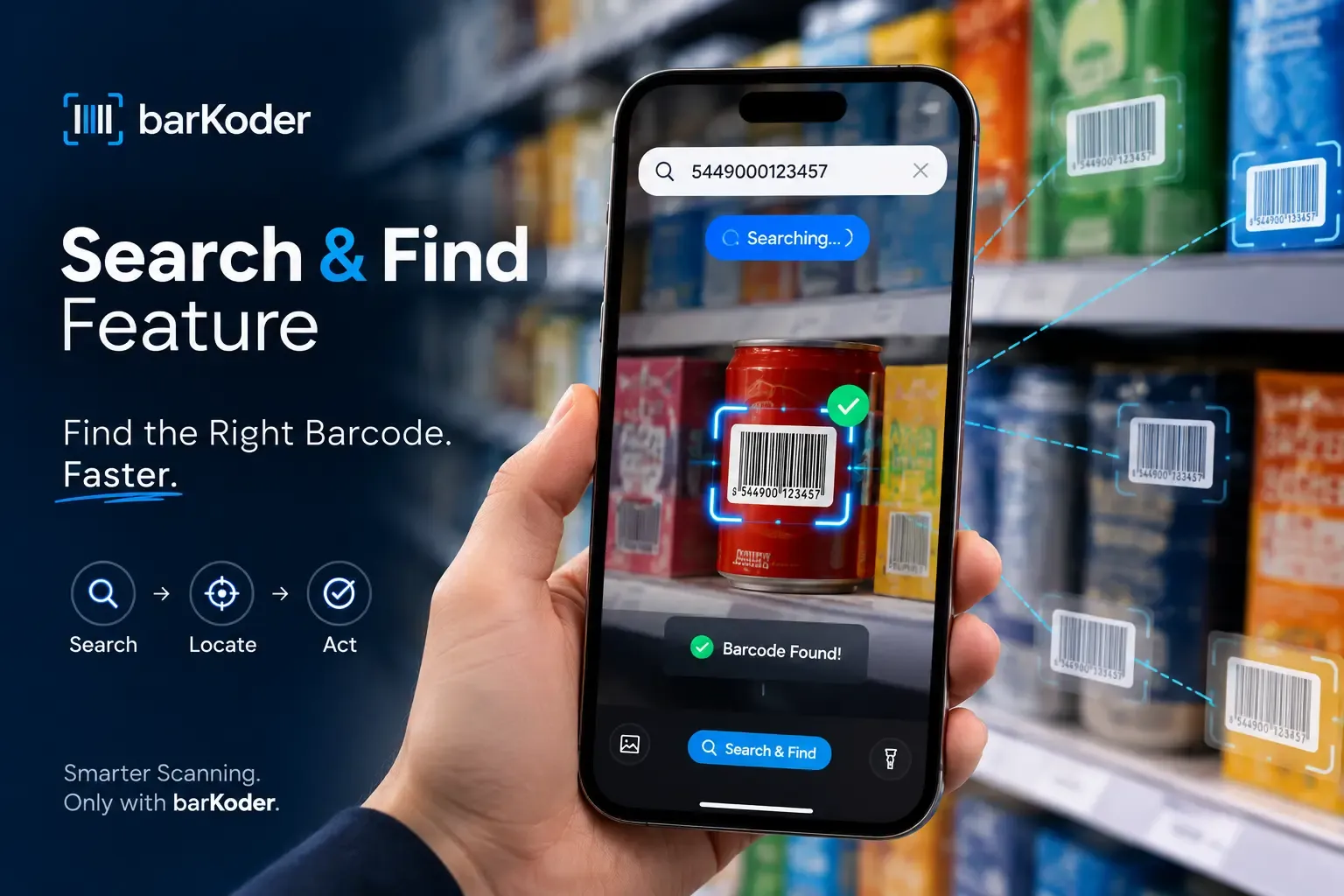
But imagine a warehouse employee looking for a specific product with barcode 5449000123457. There are 20 products on the shelf, each with its own barcode.
Without Search & Find, the user may need to scan several products until the correct one appears.
With Search & Find, the workflow changes completely.
The user enters the barcode value they need, points the camera toward the shelf, and barKoder continuously analyzes the visible codes until it identifies the requested one.
The scanner doesn't just find a barcode. It finds the barcode that matters.
How Search & Find works
At the heart of Search & Find is a flexible result filtering mechanism that gives developers control over which decoded results should be considered a match.
The system supports several ways to define what the application is looking for, including:
- Exact string matching for precise barcode values.
- Regular expression matching for more advanced search patterns.
- Regex flags, including case-insensitive matching.
- Multi-token input when applications need to search for multiple values.
Every decoded result also carries an explicit isMatched state. This allows an application to distinguish between a barcode that has been detected and one that actually satisfies the requested search criteria.
Developers can then control the returned results using returnOnlyMatchedResults.
When enabled, barKoder returns only results that match the search criteria.
When disabled, non-matching results can still be returned but they are clearly identified as unmatched.
This gives developers the flexibility to decide how much information their application needs.
From “scan anything” to “find this”
This distinction might sound small, but it can completely change the user experience.
Imagine a worker standing in front of a shelf containing dozens of products.
Instead of:
Scan → Check result → Scan again → Check result → Repeat
the workflow becomes:
Enter target → Point camera → Search → Find
The camera can continuously inspect the environment while the filtering logic determines whether a detected barcode is the one the user requested.
That means the user doesn't have to manually inspect every result.
barKoder does the searching.
Search & Find in the warehouse
Warehouses are one of the most obvious places where Search & Find can make a difference.
A single shelf can contain dozens or even hundreds of individual products, boxes, labels, and inventory codes. When a worker needs to locate one specific item, manually scanning every visible barcode can quickly become inefficient.
With Search & Find, the employee can enter the required barcode and use the camera to scan the entire area.
This can be useful for tasks such as locating a particular product, verifying inventory, finding a specific package, or identifying an item among visually similar products.
The same concept can also be applied to storage locations where several barcodes are visible within the same camera frame.
Retail: finding the right product among many
Retail environments present a similar challenge. A shelf, promotional display, or product rack can contain many barcodes packed closely together. A conventional scanner may successfully decode several of them, but that doesn't necessarily mean it has found the product the employee wants.
Search & Find adds context to the scanning process.
Instead of simply asking:
“What barcodes can you see?”
the application can ask:
“Can you find this specific barcode?”
That makes the scanning experience much more targeted.
Shipping and logistics
Shipping environments can be even more challenging. Packages and pallets may contain multiple labels, barcodes, tracking identifiers, and other machine-readable information. The user may know exactly which identifier needs to be verified but still have to locate it visually.
Search & Find can help applications narrow the process down to the specific barcode value they are expecting.
For logistics workflows, this can mean fewer unnecessary scans and a more controlled verification process.
Documents can have the same problem
The challenge isn't limited to physical products. Documents can contain multiple barcodes, QR codes, and other machine-readable elements. A user may need to locate one particular identifier without accidentally selecting another.
Search & Find gives developers the ability to define the expected result and filter decoded values accordingly.
This makes the feature useful for applications involving forms, invoices, certificates, shipping documents, identification paperwork, and other documents where multiple codes can appear together.
Less manual searching, fewer opportunities for error
One of the biggest advantages of Search & Find is that it changes the user's role. Instead of manually deciding which detected barcode is the correct one, the application can provide that logic.
The user simply tells the application what they need.
The workflow is simple:
Enter the barcode value
The user provides the barcode they want to locate.
Point the camera at the relevant area
The camera can see multiple barcodes at the same time.
Let barKoder continuously search
Detected results are evaluated against the defined matching criteria.
- Find the target
Once the requested barcode is identified, the application can react accordingly.
It is a small change to the scanning workflow, but it can eliminate a lot of unnecessary interaction.
More than just filtering results
Search & Find isn't simply about hiding unwanted results.
The explicit isMatched state gives developers additional information about every decoded result. This means applications can build their own logic around matched and unmatched codes.
For example, an application could:
- Highlight the matching barcode.
- Ignore unmatched codes.
- Display matched and unmatched results differently.
- Trigger an action when the requested code is found.
- Continue showing all decoded codes while clearly identifying the target.
- Build custom visual guidance around the matching result.
This makes Search & Find particularly interesting when combined with interactive scanning interfaces.
Search & Find meets Advanced AR
Search & Find becomes even more powerful when combined with barKoder's Advanced AR capabilities.Barcode scanning doesn't have to end with a number appearing on the screen.
Developers can build experiences where detected barcodes become interactive visual elements. A matching barcode can be highlighted, selected, tracked, or used to trigger another action within the application.
This opens the door to scanning experiences that feel much more like visual navigation than traditional barcode scanning.
Instead of simply telling the user:
“Barcode detected.”
an application can guide them toward:
“This is the barcode you're looking for.”
That difference matters when there are many codes in view.
Flexible enough for developers
Not every application needs the same matching behavior. Some workflows require an exact barcode match. Others need pattern-based matching, while some applications should return only the requested result and others need access to every decoded barcode, together with its match status.
That’s why Search & Find offers multiple levels of control.
With exact matching, developers can search for a specific barcode value. With regular expressions, they can define more advanced matching rules, while regex flags provide additional flexibility for adapting matching behavior to the application’s needs.
The returnOnlyMatchedResults option gives developers further control over the output. They can filter out unmatched barcodes or keep all decoded results available to the application, along with their matching status.
The result is a flexible feature that adapts to different scanning workflows instead of forcing every application into the same behavior.
Real-world barcode scanning is rarely perfect
Barcode scanning demos often show a single, perfectly positioned barcode against a clean background.
Real life looks very different.
Barcodes can be:
- Close together.
- Partially obscured.
- Printed on different surfaces.
- Located at different distances.
- Surrounded by other visual information.
- Positioned at different angles.
- Displayed on multiple products at once.
In these situations, simply detecting a barcode isn't necessarily the goal.
The real goal is identifying the correct barcode.
That's the problem Search & Find is designed to address.
A better scanning experience starts with a better question
Traditional barcode scanning asks:
“What did the camera detect?”
Search & Find allows the application to ask a much more useful question:
“Did the camera find the barcode I'm looking for?”
That shift from detection to intention is what makes the feature so useful.
The scanner is no longer just a tool for reading codes. It becomes part of a workflow designed around finding specific information.
Built for applications where every second counts
In inventory, retail, logistics, manufacturing, inspection, and other operational environments, small improvements to a repetitive process can add up quickly.
If an employee has to manually scan five or ten barcodes to find one specific item, that interaction is repeated hundreds or thousands of times throughout the day.
Search & Find can turn that process into a more direct experience:
Search. Locate. Confirm.
Less unnecessary scanning means less interaction for the user and a more focused application workflow.
Search smarter with barKoder
The future of barcode scanning isn't simply about decoding more barcodes.
It's about making barcode scanning more intelligent and more useful.
With barKoder Search & Find, developers can define what they are looking for and give users a faster way to locate the right code even when multiple barcodes are visible at the same time.
From warehouse shelves and retail displays to shipping labels, documents, vehicles, and equipment, Search & Find brings a new level of control to barcode scanning.
Don't just scan what's in front of you.
Find exactly what you're looking for.
Search & Find with barKoder
Less searching. Fewer mistakes. Faster scanning.
Here are the steps to enable the AR Model for Match Filter on both Android and iOS in our documentation:
You can find the complete setup instructions and code examples on our Documentation page.
Check out the YouTube Shorts preview below to see how fast barKoder pinpoints target codes:
- Shorts Video: Watch barKoder Search & Find Short