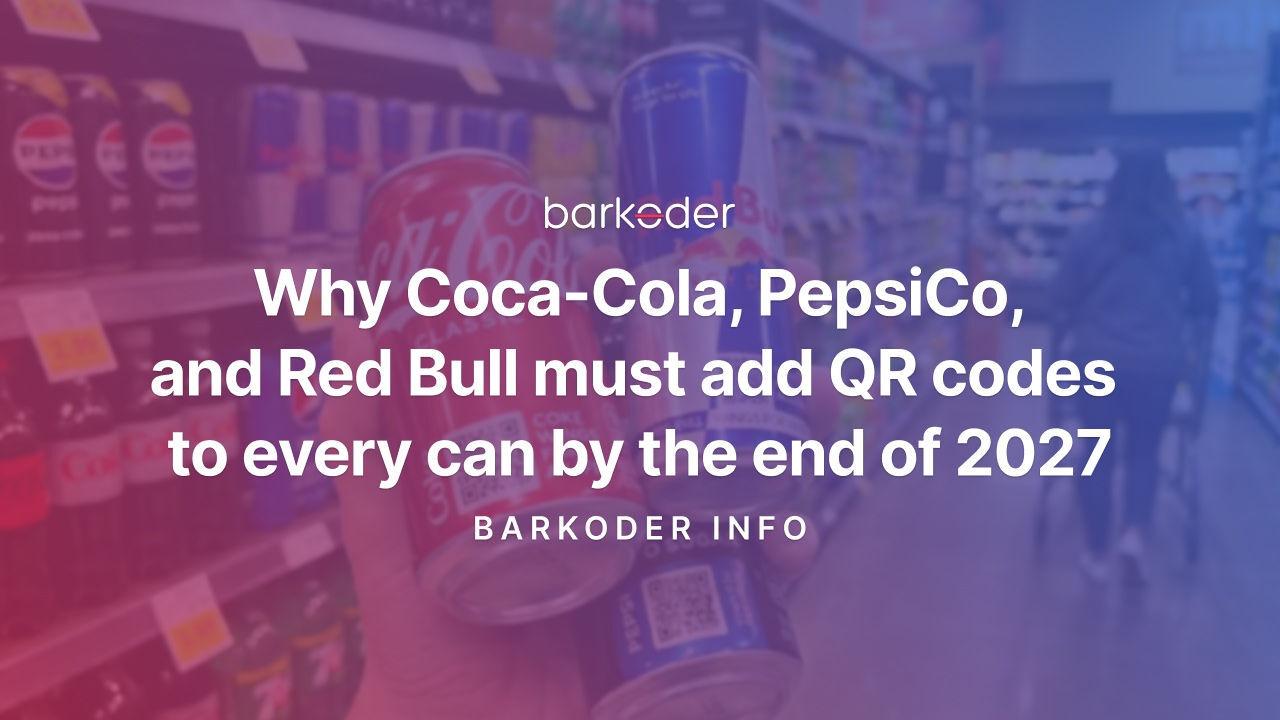
Why Coca-Cola, PepsiCo, and Red Bull Must Add QR Codes to Every Can by the End of 2027
The humble beverage can is undergoing one of the biggest technological transformations since the invention of the retail barcode. For decades, consumers have barely noticed the black-and-white barcode printed somewhere on the side of every can, bottle, and food package. It has served one primary purpose allowing retailers to identify products quickly at checkout. While this technology revolutionized retail in the 1970s, today's connected world demands much more than a simple product identifier.
By the end of 2027, many of the world's largest beverage manufacturers, including Coca-Cola, PepsiCo, and Red Bull, are expected to include QR codes or other next-generation two-dimensional (2D) barcodes on nearly all consumer packaging. This transition is being driven by the global GS1 Sunrise 2027 initiative, which encourages retailers, manufacturers, and technology providers to modernize product identification using advanced digital barcodes. Rather than replacing traditional retail systems overnight, Sunrise 2027 establishes the foundation for a future where a single QR code can support checkout, product information, sustainability, traceability, and customer engagement all at once.
Unlike previous packaging trends that focused primarily on branding or aesthetics, this transformation is rooted in real business needs. Consumers expect immediate access to accurate information, retailers want better inventory visibility, governments are introducing stricter sustainability requirements, and manufacturers are looking for smarter ways to manage products throughout increasingly complex global supply chains. Digital packaging provides a solution that benefits every participant in the retail ecosystem.
A New Generation of Product Packaging
For more than fifty years, the UPC and EAN barcode have remained largely unchanged. Every time a cashier scans a product, the barcode simply identifies the item by referencing a number stored inside the retailer's database. The barcode itself contains very little information, and consumers cannot use it to learn much about the product.
Modern QR codes based on the GS1 Digital Link standard represent a significant leap forward. Instead of storing only a product number, they can provide a digital gateway to an enormous amount of information while still functioning as a retail barcode. When scanned at a checkout counter, the code identifies the product just as a traditional barcode would. When scanned with a smartphone, however, the very same code can connect the customer directly to official manufacturer content.
This dual-purpose functionality is one of the primary reasons global brands are investing heavily in digital packaging. Rather than printing multiple codes across a product label, manufacturers can eventually rely on one standardized symbol capable of serving retailers, supply chain partners, regulators, and consumers simultaneously.
More information about the initiative is available from GS1: https://www.gs1.org/standards/2d-barcodes/sunrise-2027 and our blog: Get Ready for GS1 Sunrise 2027: Preparing for the Future of Global Standards - https://barkoder.com/blog/get-ready-for-gs1-sunrise-2027-preparing-for-the-future-of-global-standards
Why Beverage Companies Are Leading the Transition
Few industries manufacture products at the scale of the global beverage market. Coca-Cola alone sells billions of beverages every year across hundreds of countries. PepsiCo manages an equally complex portfolio of drinks and snack products, while Red Bull distributes energy drinks to virtually every major market in the world.
Managing this enormous product ecosystem requires packaging that can adapt quickly to changing regulations, multiple languages, regional promotions, and evolving consumer expectations. Traditional printed labels often become outdated shortly after production because regulations change, recipes evolve, or marketing campaigns end. Updating printed packaging for every market can be both expensive and time-consuming.
QR codes solve many of these problems by allowing companies to move much of the product information online. Instead of redesigning an entire can whenever nutritional guidance changes or new recycling instructions become available, manufacturers can simply update the digital content linked to the QR code. The physical package remains unchanged while the information accessed through the scan stays current.
This flexibility becomes especially valuable for multinational companies operating across dozens of countries where legal requirements differ significantly from one market to another.
Consumers Want More Information Than Ever Before
Today's shoppers are far more informed than previous generations. Before making a purchase, many consumers want to know exactly where a product was manufactured, what ingredients it contains, whether allergens are present, how much caffeine it includes, and how the packaging should be recycled.
Unfortunately, beverage cans provide only a limited amount of space. Companies often struggle to include all the required information while still maintaining attractive branding. Printing extensive text in multiple languages quickly fills the available surface area.
Digital packaging removes these physical limitations. After scanning a QR code, consumers can immediately access official information directly from the manufacturer, presented in their preferred language and updated whenever necessary. Rather than relying on third-party websites or outdated printed labels, customers receive accurate information straight from the brand.
This increased transparency helps build trust between manufacturers and consumers while making important product details easier to access than ever before.
Sustainability Is Becoming a Global Priority
Sustainability has become one of the strongest drivers behind packaging innovation. Governments across Europe and many other regions are introducing new environmental regulations aimed at reducing waste, improving recycling rates, and supporting the circular economy.
QR codes play an important role in these initiatives because they provide consumers with clear recycling guidance that can vary between countries and municipalities. A single beverage can may require different disposal methods depending on local recycling systems, deposit return programs, or environmental regulations. Digital packaging allows manufacturers to present location-specific recycling information without redesigning the physical label for every market.
Companies are also using QR codes to communicate broader sustainability efforts, including recycled material usage, carbon reduction initiatives, renewable energy investments, and responsible sourcing programs. Consumers increasingly expect this level of transparency when evaluating the brands they choose to support.
Information about sustainability efforts can be found on the companies' official websites:
- Coca-Cola: https://www.coca-colacompany.com/sustainability
- PepsiCo: https://www.pepsico.com/sustainability
Digital Packaging Improves Product Safety
Another important advantage of QR codes is improved product traceability. Beverage manufacturers operate highly sophisticated supply chains involving raw material suppliers, production facilities, distributors, warehouses, transportation companies, retailers, and consumers.
If a quality issue or food safety concern arises, digital identification makes it easier to locate affected products and communicate recall information quickly. Consumers scanning a product can immediately determine whether their purchase is part of a recall and receive official guidance directly from the manufacturer.
In some markets, companies are also exploring serialized QR codes that help identify counterfeit products. Counterfeit beverages continue to be a concern in several regions around the world, particularly for premium imported products. Digital identification helps manufacturers verify authenticity while giving consumers greater confidence that they have purchased a genuine product.
Creating Interactive Customer Experiences
Marketing has changed dramatically over the past decade. Traditional packaging can only communicate so much before running out of space, but QR codes effectively transform every beverage can into an interactive digital platform.
After scanning the code, consumers might discover promotional campaigns, exclusive videos, sports sponsorship content, music playlists, loyalty rewards, competitions, limited-edition experiences, or personalized offers based on their location. Because this content exists online rather than on the package itself, companies can continuously refresh campaigns without altering the physical design of the can.
This creates ongoing engagement that extends well beyond the moment of purchase. A simple beverage can becomes a direct communication channel between the brand and its customers.
Retailers Are Preparing for Sunrise 2027
The success of digital packaging depends not only on manufacturers but also on retailers. Around the world, supermarkets and retail chains are upgrading their checkout systems to recognize next-generation 2D barcodes alongside traditional UPC and EAN codes.
This industry-wide modernization is known as GS1 Sunrise 2027. Importantly, the initiative does not require every retailer or manufacturer to abandon traditional barcodes immediately. Instead, it establishes a common target date by which retail systems should be capable of reading both conventional barcodes and standardized QR codes.
As adoption grows, many products may eventually require only a single code that serves both checkout operations and consumer engagement. This simplifies packaging while opening new opportunities for innovation throughout the retail industry.
Mobile Barcode Scanning Is Driving the Future
The widespread adoption of smartphones has made this transition practical. Nearly every modern mobile device can scan QR codes directly using its built-in camera without requiring additional hardware or specialized software.
For businesses developing retail, logistics, inventory, or consumer applications, high-performance scanning technology has become increasingly important. Solutions such as barKoder Barcode Scanner SDK enable developers to integrate fast, reliable barcode and QR code scanning into mobile applications capable of handling real-world conditions such as damaged labels, poor lighting, reflective packaging, or partially obscured codes.
As billions of digitally enabled beverage packages enter the global market over the coming years, reliable scanning performance will become an essential component of the overall customer experience.
Learn more about barcode scanning technology: https://barkoder.com
The Future of Beverage Packaging
The adoption of QR codes on beverage cans is much more than a simple packaging update. It reflects a broader transformation taking place across the retail industry, where physical products are becoming digitally connected throughout their entire lifecycle. From manufacturing and distribution to retail checkout and post-purchase engagement, digital identification allows companies to communicate more effectively, operate more efficiently, and provide consumers with better access to information.
For global beverage leaders such as Coca-Cola, PepsiCo, and Red Bull, adopting QR codes is not merely about following a trend—it is about preparing for the next generation of retail. As GS1 Sunrise 2027 gains momentum, consumers can expect to see digital barcodes becoming the new standard across supermarkets, convenience stores, and vending machines worldwide. The beverage can of the future will no longer be just a container for a drink; it will serve as a gateway to trusted information, sustainability initiatives, interactive experiences, and smarter retail technology that connects brands and consumers in ways that were impossible with traditional barcodes alone.
Frequently Asked Questions
GS1 Sunrise 2027 is a global industry initiative encouraging retailers and manufacturers to upgrade point-of-sale systems to scan next-generation two-dimensional (2D) barcodes, such as standard QR codes, by the end of 2027. For beverage packaging, this means transitioning from traditional 1D barcodes to a single 2D code that can handle retail checkout while simultaneously delivering digital product information to consumers.
No. Sunrise 2027 establishes a target for retail systems to accept both traditional 1D barcodes and 2D barcodes simultaneously. Traditional UPC/EAN barcodes will not be instantly phase-out overnight; rather, the initiative lays the foundation for a transition period where dual-purpose QR codes become the new standard.
Physical packaging offers limited surface area, making it difficult to print updating regulations, multi-language details, and localized recycling instructions. By using QR codes based on the GS1 Digital Link standard, manufacturers can host detailed compliance and sustainability data online. Brands can update recycling guidance, allergen details, or carbon footprint data in real time without having to redesign physical packaging for every region.
Unlike traditional barcodes, which only store a static product number readable by retail cash registers, modern QR codes can be scanned directly with a smartphone. Consumers gain immediate access to verified brand information—including ingredient sourcing, caffeine content, food safety recall alerts, and interactive marketing campaigns - in their preferred language.
As billions of beverage cans enter supply chains with 2D barcodes, applications used by retailers, warehouse staff, and mobile consumers must scan codes accurately under real-world conditions. High-performance enterprise scanning solutions, such as the barKoder Barcode Scanner SDK, ensure fast and reliable reading of 2D codes even when dealing with reflective curved surfaces, low light, or damaged labels on beverage packaging.