If you read our earlier post on GS1 Sunrise 2027, you already know the headline: by the end of 2027, retail point-of-sale systems around the world are expected to scan 2D barcodes alongside the classic UPC/EAN, a target GS1 US describes as the industry's move toward greater transparency, stronger traceability, and richer supply chain data. But what actually goes inside that 2D barcode is a separate, more interesting question — and the answer is a GS1 standard called Digital Link.
Digital Link is the piece of the puzzle that turns a plain QR code into something a checkout lane, a warehouse scanner, and a customer's phone can all read at the same time, each getting something different out of the same scan. It's arguably the most important technical detail behind Sunrise 2027, and it's the part most businesses still don't fully understand.
Here's what GS1 Digital Link is, how it's structured, and what your team needs to do before 2027 arrives.
What Is GS1 Digital Link?
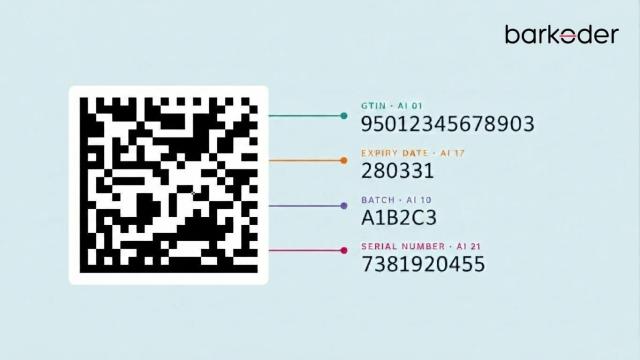
GS1 Digital Link is a standard that takes the identifiers your business already uses — GTIN (product number), batch/lot, serial number, expiration date, and more — and encodes them as a structured, web-addressable URL inside a QR code or GS1 DataMatrix symbol, the two 2D barcode formats at the center of the Sunrise 2027 transition. As GS1's own Sunrise 2027 resource explains, the goal is a single symbol that gives retailers stronger traceability while giving consumers direct access to richer product data.
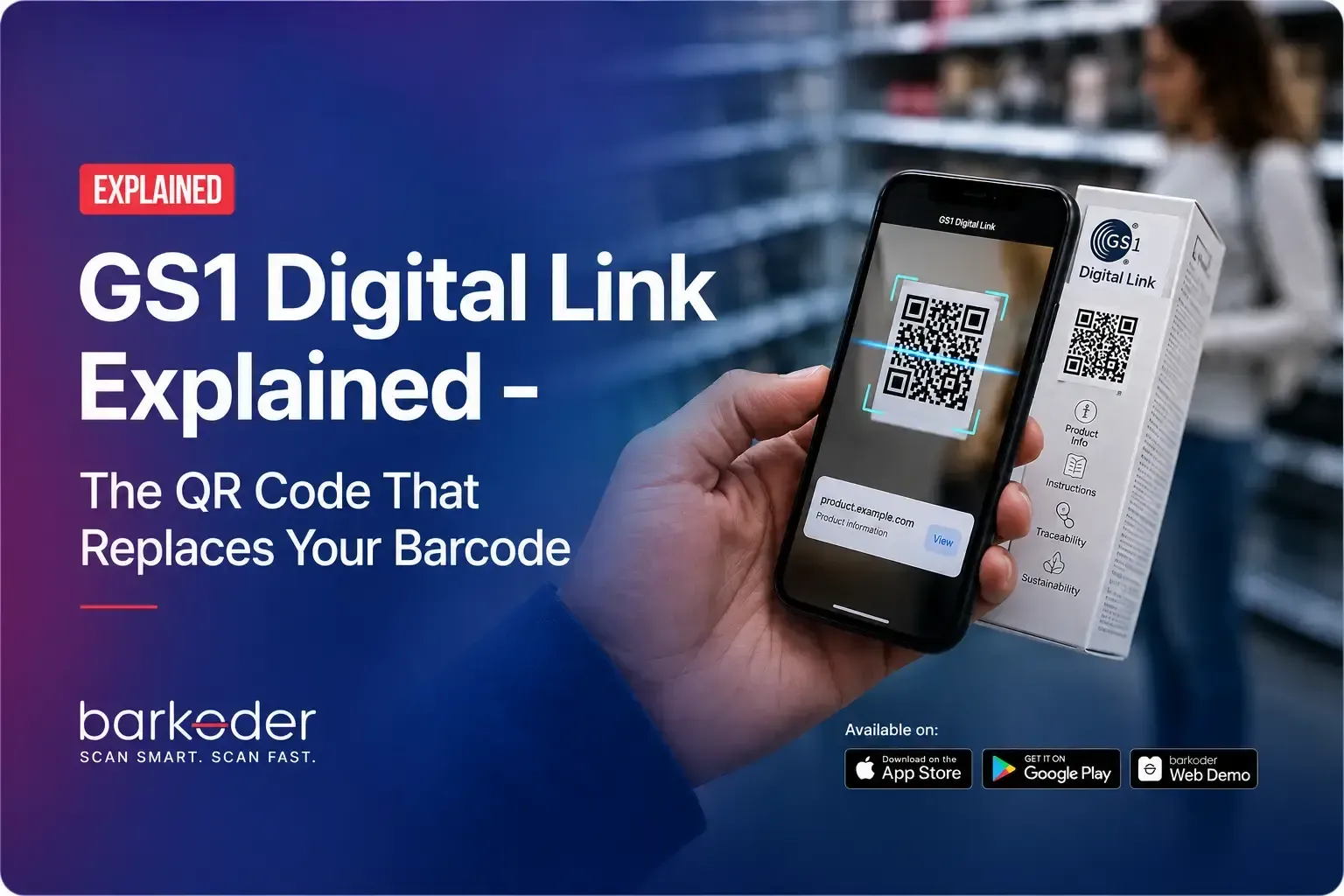
Instead of a barcode that only holds a number, you get a barcode that holds a real web address. A retail POS system scans it and extracts the GTIN to ring up the sale, exactly like it would with a traditional barcode. A consumer's phone camera scans the very same code and opens a live product page - ingredients, care instructions, recall notices, sustainability data, loyalty offers, whatever the brand wants to show. One symbol, two completely different audiences, no compromise on either side.
That dual purpose is precisely why GS1 built Digital Link into the Sunrise 2027 initiative: it lets brands stop choosing between "a barcode that works at checkout" and "a QR code that engages the customer." After the transition, it's the same code doing both jobs.
Inside a Digital Link URL
A GS1 Digital Link URL isn't just any link - it follows a strict structure defined by application identifiers (AIs), the same short numeric codes that have identified data fields inside GS1 barcodes for decades. A typical Digital Link might look like this:
https://gs1.example/01/09506000164908/10/ABC123/17/261231
Reading it left to right: 01 is the AI for GTIN, so 09506000164908 is the product identifier. 10 is the AI for batch or lot number, here ABC123. 17 is the AI for expiration date, encoded as 261231 for 31 December 2026. A POS system reads the structured path, pulls out the GTIN, and completes the transaction. A phone follows the same URL to a brand-hosted landing page.
Brands don't need to build or host their own resolver infrastructure for this to work — GS1 operates a global resolver service that maps a product's GTIN to whatever destination the brand currently wants customers sent to, a mechanism explained in more technical detail by GS1 Digital Link implementers such as LinkScan. Change the destination once, centrally, and every code already printed on packaging anywhere in the world routes to the new page instantly. No reprinting required.
This is also the detail that trips brands up most often: a generic QR code that simply links to your homepage will not satisfy Sunrise 2027 requirements. As TrackVision's breakdown of the standard notes, retail POS systems are built to parse the specific GS1 Digital Link path structure defined under ISO/IEC 18975 and pull a validated, licensed GTIN out of it - a plain marketing QR code carries no such structure and will be rejected at checkout.
GS1 Digital Link vs. GS1 DataMatrix
You'll see two symbologies mentioned constantly in Sunrise 2027 material, and it's worth being precise about the difference:
- GS1 DataMatrix is the compact, high-density symbol long used in pharmaceuticals and industrial marking, where label space is tiny and the code needs to survive laser etching, thermal printing, or direct part marking.
- QR Code with GS1 Digital Link is the format best suited to retail and direct-to-consumer packaging, because the same symbol a shopper already knows how to scan with their phone also carries the structured GS1 data a POS system needs.
Both are valid 2D carriers under Sunrise 2027, and which one you use often comes down to industry convention and available label space rather than a hard rule. Some categories - batteries under the EU's Digital Product Passport requirement, which becomes mandatory under Regulation 2023/1542 in February 2027, for instance — are moving toward Digital Link QR codes specifically because the consumer-facing link is part of the compliance requirement, not just a nice-to-have.
Living With Dual Marking
Nothing about 1 January 2028 flips a switch. During the transition, packaging is expected to carry both a traditional linear barcode and a 2D Digital Link code side by side - a practice GS1 calls dual marking. This keeps products sellable at stores whose POS systems haven't upgraded yet, while letting Digital Link-ready retailers and consumers take advantage of the richer code immediately.
GS1 has published detailed placement guidance, outlined in its 2D Barcodes at Retail Point-of-Sale Implementation Guideline, so the two symbols don't interfere with each other at checkout: both codes need to sit within a defined radius of each other so a single scanner sweep can pick up whichever one it's built to read, whether that's a handheld imager, a fixed POS scanner, or a phone camera.
What Retailers Need to Do Now
The heaviest lift in this transition falls on retailers, because every scanning point in the store - checkout lane, handheld gun, self-checkout kiosk - has to be able to read a 2D symbol and correctly parse GS1 data out of it. Three things to check today:
- Audit your scanner fleet. Laser scanners physically cannot read 2D codes - they sweep a single line of light, and a QR code or DataMatrix is invisible to them. Imager-based scanners read both 1D and 2D and have been the standard new-install hardware for years, but legacy laser units still dominate many store estates. If your checkout terminals or handhelds run on Android, iOS, Windows, or Linux, you don't necessarily need new hardware at all - a camera-based SDK can turn an existing device's camera into a 2D-capable scanner.
- Confirm your POS software actually parses Digital Link. Recognizing a QR code is not the same as extracting a GTIN from a structured GS1 URL and handling the rest of the AI data correctly. Ask your POS vendor specifically what happens after the scan, not just whether the hardware can read the symbol. Web-based POS or self-checkout kiosks can test this instantly with the barKoder Web Demo, which runs the WASM SDK directly in the browser.
- Train frontline staff. A 2D code looks and scans differently than a UPC, and if expiry or batch data trigger automated pricing or markdown logic at the register, staff need to know what to expect.
What Brands and Manufacturers Need to Do Now
Packaging cycles are slow, and that's exactly why 2026 - not 2027 - is the year that matters for brand owners:
- Register and validate your GTINs, and make sure any existing QR code on your packaging is rebuilt to the Digital Link structure rather than a plain marketing link. You can prototype the structure itself with a free QR Code generator before committing it to packaging artwork, or use the barKoder Barcode Generator to produce print-ready 1D and 2D symbols for dual marking.
- Plan for dual marking on any packaging artwork going to print now, since anything printed in 2026 will likely still be on shelves well after the Sunrise date.
- Test print quality, not just on-screen scans. A Digital Link QR code that scans perfectly from a monitor can still fail on press once it's shrunk onto a label, printed on foil, or wrapped around a curved surface. Verify symbol quality against ISO/IEC 15415 before mass production, and stress-test the final artwork with a scanner that handles deformed, damaged, or blurry real-world codes, not just clean lab samples.
- Decide what the link actually shows. Digital Link is only as valuable as the landing page behind it — product content, sustainability data, batch-level recall information, and loyalty or marketing experiences all belong on the other end of that scan.
Who's Already Moving
This isn't a theoretical, someday initiative. Major retailers including Walmart, Carrefour, Woolworths, and Tesco have published 2D roadmaps and are already piloting Digital Link codes in live stores. Pharmacy has effectively lived in this world for a while: under the U.S. Drug Supply Chain Security Act, every salable pharmaceutical unit already carries a GS1 DataMatrix encoding GTIN, serial number, lot, and expiry, with serialization enforcement already in effect across manufacturers, wholesalers, and large dispensers. Retail is now walking toward the same package-level data capture that pharmacy has already solved - the kind of high-stakes, regulation-driven scanning our AAMVA PDF417 guide covers on the identity-document side of the same problem.
How barKoder Fits In
Reading a 2D symbol is only step one — a scanner also has to correctly decode the GS1 Application Identifiers packed inside a Digital Link URL or a GS1 DataMatrix, and hand your systems clean, structured data instead of a raw string to parse yourself. That's exactly what the barKoder Barcode Scanner SDK is built for, with a dedicated GS1 Parser that extracts GTIN, batch, serial, and expiration data automatically from any GS1-compliant QR Code or Data Matrix symbol — on any modern camera-equipped device, without new hardware.
The SDK ships for every stack a retail or brand team is likely to run: native Android and iOS, WASM for browser-based POS, Windows, Linux, Python, and C#, plus framework wrappers for React Native, Flutter, .NET MAUI, Cordova, Capacitor, and NativeScript. You can try 2D and GS1 scanning right now with the free barKoder Barcode Scanner app, see pricing for your rollout size, or request a quote if you're scoping a retailer- or brand-wide Sunrise 2027 project. Full integration details live in the barKoder Docs.
Whether you're a retailer upgrading POS scanning logic or a brand building a mobile app that reads your own Digital Link packaging, an SDK that already speaks GS1 fluently removes one of the biggest technical unknowns of the Sunrise 2027 transition. See how other teams have approached it in our customer stories and industry pages.