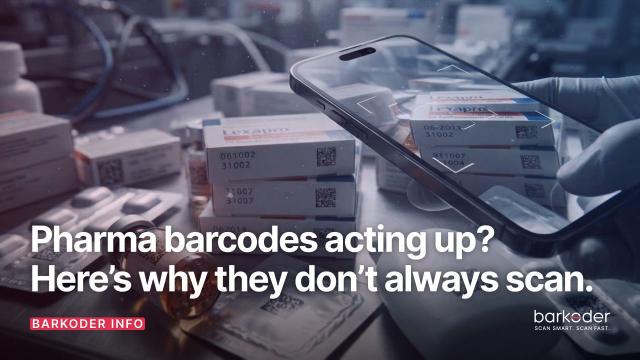
In the world of automated data capture, the "perfect scan" is a rarity. In real-world environments-like a high-speed pharmaceutical lab or a bustling grocery checkout-barcodes are rarely flat, pristine, or perfectly aligned. They are wrapped around test tubes, crumpled on delivery bags, or distorted on plastic bottles.
Most standard barcode scanners share a common weakness: they require at least one straight line to pass through every bar of a 1D code to decode it. If the code is curved or deformed to the point where no such line exists, the scanner fails.
At barKoder, we solved this with Segment Decoding®.
1. What is Segment Decoding®?
Segment Decoding® is a proprietary algorithm exclusive to the barKoder SDK. Instead of trying to find a single "magic line" through the entire barcode, our engine identifies individual segments of the code and digitally reassembles them into a readable format.
Think of it as a puzzle. Traditional scanners try to see the whole picture at once. Segment Decoding® identifies the pieces, understands their relationship to each other, and completes the picture-even if the physical label is warped beyond recognition.
2. Key Challenges Solved by Segment Decoding®
Scanning on Curved Surfaces
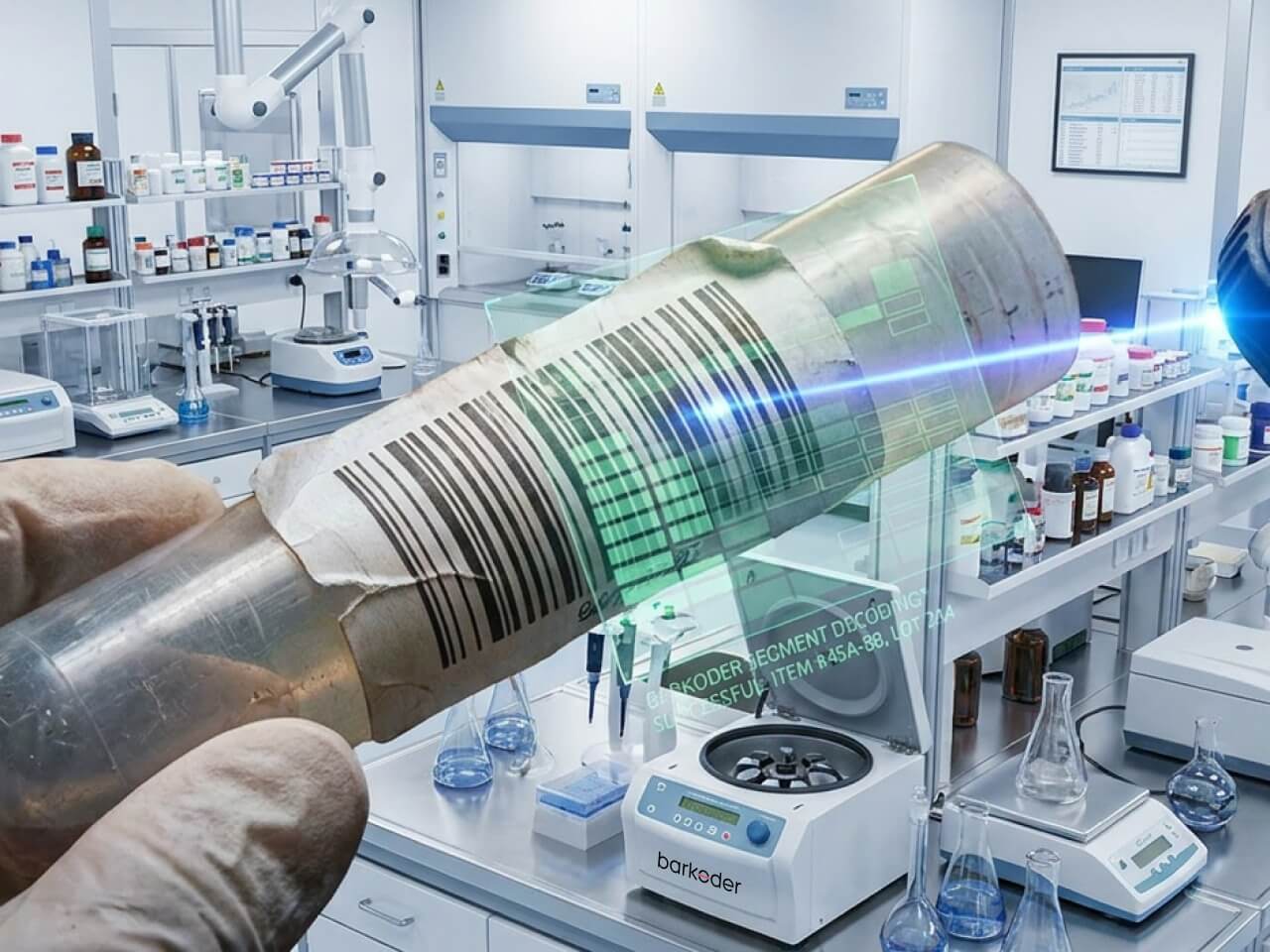
In healthcare and cosmetics, small 1D barcodes are often applied to cylindrical objects like vials, syringes, and lipsticks. When a camera looks at these, the edges of the barcode "taper off" due to the Z-axis curve.
- The barKoder Advantage: Using our Segment Decoding® feature, users can scan these curved labels from any angle without needing to rotate the object perfectly.
Crumpled and Distorted Labels
Logistics and "last mile" delivery drivers often deal with poly-bags and padded envelopes that have been squashed during transit. A crumpled barcode creates multiple "folds" that break the linear path of a laser or standard software scanner.
- The barKoder Advantage: Our engine treats each fold as a separate segment, intelligently stitching the data back together. This feature is a core component of our Logistics solutions.
Low-Resolution and Motion Blur
When a user is moving quickly, motion blur can "smear" the bars of a code. Combined with our DeBlur Mode, Segment Decoding® ensures that even a partial, blurry frame can yield a successful read.
3. Beyond 1D: A Suite of Advanced Algorithms
While Segment Decoding® handles the 1D world, barKoder offers a specialized toolkit for 2D and complex data carriers as well:
- MatrixSight®: Our "silver bullet" for QR codes and Data Matrix codes that are missing their corners (finder patterns) or have significant central damage.
- LineSight®: Designed specifically for PDF417 codes (found on US Driver's Licenses), allowing for successful reads even if the start or stop patterns are completely destroyed.
- DPM Mode: For the manufacturing sector, our DPM (Direct Part Marking) engine can read codes etched directly into metal, plastic, or glass.
4. Integration into Your Tech Stack
The beauty of Segment Decoding® is that it doesn't require specialized hardware. It is a software-level upgrade that works on any standard smartphone or tablet camera. Developers can easily toggle this feature within our cross-platform plugins:
- Mobile Frameworks: Full support for Flutter, React Native, and Capacitor.
- Web Integration: Implement these robust features in the browser using our WebAssembly SDK.
- Enterprise Apps: Seamlessly add it to .NET MAUI or Xamarin projects.
5. Why It Matters for Your Bottom Line
Every "No-Read" costs money. In a warehouse, a 2% failure rate in scanning can lead to hundreds of hours of manual data entry over a year. By implementing Segment Decoding®, enterprises can:
- Reduce Hardware Costs: Move from $1,000+ rugged scanners to standard mobile devices.
- Increase Throughput: Employees spend less time "fiddling" with an object to get a scan.
- Improve Data Integrity: Automating the capture of damaged codes reduces the human error inherent in manual typing.
Conclusion: The New Standard in Robust Scanning
Segment Decoding® isn't just an "extra" feature; for many industries, it is the difference between a functional workflow and a broken one. As barcode technology continues to evolve, barKoder remains committed to solving the "unscannable" problems of the real world.
Ready to test Segment Decoding® against your most difficult barcodes? Download our demo app or sign up for a free 30-day trial license to see it in action.