In the fast-paced ecosystems of modern logistics, retail, warehousing, healthcare, and manufacturing, data capture is the heartbeat of efficiency. Historically, businesses had to rely on rugged, dedicated hardware scanners to ensure accurate and rapid data ingestion. However, these dedicated handheld devices come with steep upfront capital expenditures, high maintenance liabilities, and rigid operational boundaries.
The widespread adoption of high-performance smartphones has initiated a major technological shift. Businesses can now completely bypass costly hardware setups. By integrating a software-only barcode decoder SDK, organizations can turn a smartphone into an industrial barcode reader that rivals - and often exceeds - traditional dedicated hardware scanners.
The Paradigm Shift: Hardware vs. Software-Driven Mobile Data Capture
Relying on hardware scanners creates a variety of operational bottlenecks. If a dedicated terminal breaks, operations halt until a costly replacement is provisioned. Additionally, frontline workers are forced to manage multiple single-purpose electronic devices simultaneously.
Transitioning to a no hardware barcode scanning solution eliminates these physical limitations. By unlocking the computing potential of modern mobile devices, companies can implement Bring Your Own Device (BYOD) or corporate-owned, personally enabled (COPE) deployment strategies.
This software-driven architecture transforms every employee's personal device into a highly robust enterprise data collection tool. It relies entirely on a modern smartphone camera barcode scanning engine to handle complex light fluctuations, skewed viewing angles, and physically compromised labels with exceptional speed.
Deep Dive Into the barKoder Enterprise Engine
The foundation of any successful transition to mobile data capture lies in the algorithmic intelligence of the underlying decoder. The barKoder Barcode Scanner SDK provides high-end barcode recognition designed to run natively on mobile and web environments.
Unlike basic open-source scanning libraries that struggle outside of perfect laboratory conditions, barKoder utilizes a suite of proprietary algorithms engineered for real-world enterprise environments:
- MatrixSight®: Traditional 2D matrix symbologies (like QR Codes and Data Matrix) become completely unreadable by standard scanners if key elements, such as finder patterns, are scratched or torn. The barKoder MatrixSight® algorithm reconstructs missing components, extracting data from severely damaged 2D barcodes.
- Segment Decoding®: When 1D linear codes (such as Code 39 or Code 128) are affixed to curved surfaces like bottles, or crumpled on plastic freight wrapping, they suffer from severe multi-axis distortion. barKoder’s Segment Decoding technique isolates and mathematically aligns fragment patterns to achieve successful reads on heavily warped surfaces.
- DeBlur Mode: Low-resolution cameras or fast-moving workers often produce motion-blurred images. barKoder incorporates advanced digital image processing directly into its engine to instantly clarify heavily blurred EAN and UPC codes.
Seamless Multi-Platform Deployment Options
Enterprise architectures rarely rely on a single operating system or runtime platform. To maximize utility across an entire organization, a modern data capture framework must deploy effortlessly across native mobile platforms, web applications, and hybrid development frameworks.
1. Cross-Platform Mobile Applications
Building distinct applications for diverse mobile operating systems can strain development resources. Implementing a comprehensive cross-platform mobile data capture SDK ensures your engineering team can write a single codebase that delivers uniform, lightning-fast barcode scanning performance across both iOS and Android platforms. The barKoder framework offers native integrations alongside dedicated modules for all major hybrid frameworks, including:
- Flutter: Seamlessly inject rapid computer-vision capabilities into your Dart code with the barKoder Flutter Barcode Scanner Plugin.
- React Native: Effortlessly deploy an enterprise-grade scanning interface across platforms with the barKoder React Native Barcode Scanner Plugin.
- Capacitor: Bridge web asset applications with underlying native performance using the barKoder Capacitor Barcode Scanner Plugin.
- .NET MAUI / Xamarin: Empower your specialized C# ecosystem using the modern, high-speed barKoder .NET MAUI Barcode Scanner SDK.
- Cordova & NativeScript: Maintain total flexibility for legacy or light footprint web-wrapper systems through the official barKoder Cordova Documentation and the barKoder NativeScript Documentation.
2. Next-Generation Web Applications
Not every workflow requires a dedicated native app from an app store. Many modern enterprise tools are built as agile web apps accessible through standard mobile browsers.
With the barKoder Web (WASM) SDK, developers can embed a mobile browser camera barcode reader directly into any standard web page. Powered by WebAssembly, this engine executes highly optimized code directly inside the browser client, enabling instant barcode extraction from a live video stream.
Maximizing Workflow Throughput with Advanced Features
Simply decoding a single barcode at a time is often insufficient for high-volume environments like distribution hubs or fulfillment centers. To truly optimize efficiency, barKoder incorporates specialized enterprise operational modes:
Batch MultiScan and Continuous Processing
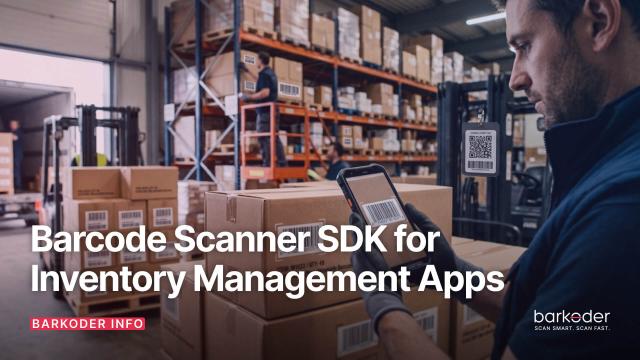
In large warehouses, scanning twenty distinct inventory boxes individually creates a massive operational bottleneck. barKoder features an advanced Batch MultiScan engine equipped with augmented reality (AR) overlays. Workers can point their smartphone camera at an entire pallet, and the engine detects, tracks, and extracts data from every barcode in the frame simultaneously, displaying real-time visual confirmations right on the screen.
Specialized Industrial Symbologies
Beyond consumer-grade QR codes, barKoder excels at reading highly specialized industrial markings. This includes DotCode markings used extensively in the tobacco industry, high-density PDF417 barcodes found on global logistics labels, and Direct Part Marking (DPM) types directly etched or engraved onto automotive and aerospace components.
Additionally, the engine includes an integrated camera based inventory scanning API capable of parsing complex automotive Vehicle Identification Numbers (VIN) and scanning Machine Readable Zones (MRZ) on passports, travel documents, and ID cards via the barKoder MRZ Scanner.
The Economic Impact of Software-Defined Scanning
Transitioning away from physical hardware scanning devices directly improves an organization's bottom line. The initial capital expenditure for a fleet of rugged hardware scanners can run into thousands of dollars per unit - often ranging between $1,500 and $2,500 when factoring in proprietary charging cradles, docking stations, and service contracts. In contrast, leveraging a software-only SDK allows businesses to deploy enterprise data capture capabilities onto existing smartphone infrastructure instantly, allowing organizations to outfit multiple workers for the cost of a single legacy device.
The financial impact of this shift is heavily validated by major enterprise mobility leaders. As detailed in Samsung’s Enterprise Mobility Insights, consolidating workflows onto multi-use smart devices allows organizations to completely eliminate traditional single-purpose scanners or hardware sleds. By shifting to software-based data capture deployed across standard or ruggedized mobile fleets, businesses significantly minimize maintenance, eliminate rigid depot contracts, and drive down the total cost of ownership (TCO) while maximizing frontline worker efficiency.