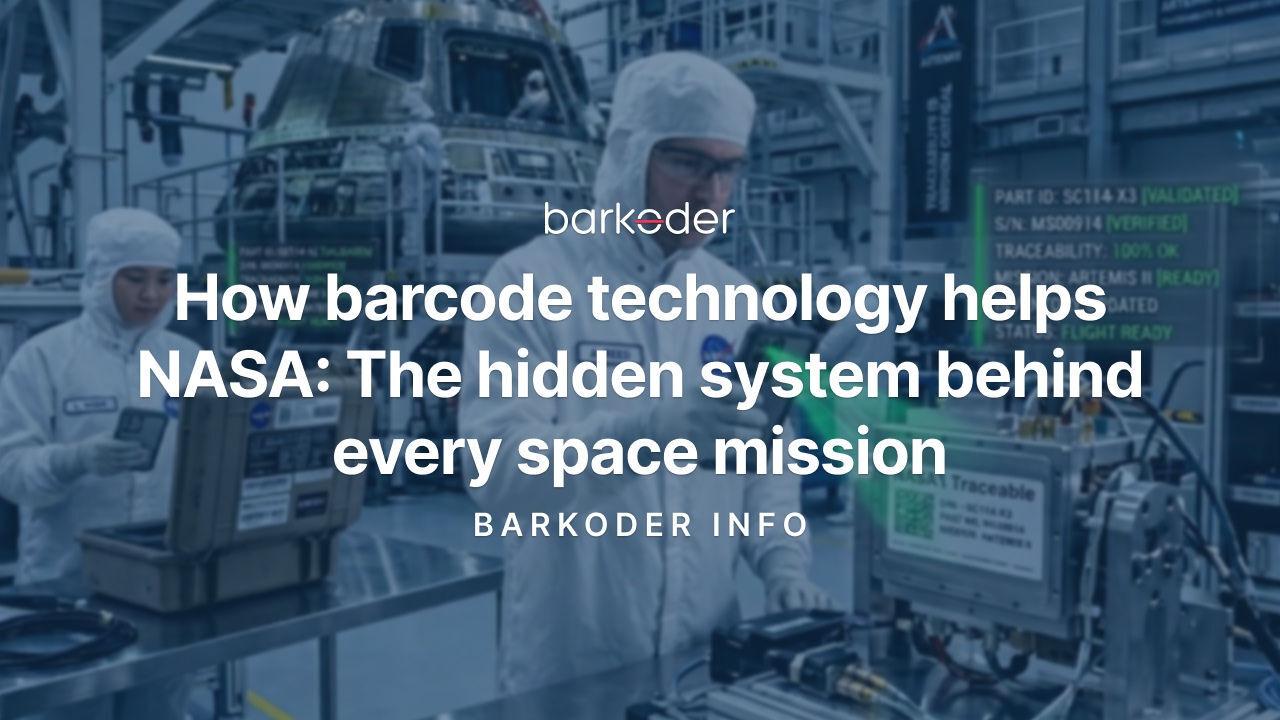
How Barcode Technology Helps NASA: The Hidden System Behind Every Space Mission
When people imagine NASA, they think of massive rockets launching into the sky, astronauts floating aboard the International Space Station, or breathtaking images captured by space telescopes billions of light-years away. These remarkable achievements are often associated with cutting-edge propulsion systems, artificial intelligence, robotics, and advanced materials. Yet behind every successful mission is a much quieter technology that rarely receives attention: the barcode.
It may sound surprising, but barcode technology plays a significant role in helping NASA organize the enormous amount of equipment, tools, scientific instruments, and spacecraft components required for every mission. While a barcode cannot launch a rocket or navigate a spacecraft, it ensures that the right component reaches the right engineer at the right time and in space exploration, that level of precision can make all the difference.
Every successful mission begins long before countdown. Years before a rocket leaves the launch pad, thousands of engineers, technicians, scientists, and contractors are already working together across multiple locations. Millions of parts move through manufacturing facilities, testing laboratories, warehouses, clean rooms, and launch sites. Keeping track of this enormous flow of equipment would be nearly impossible without reliable identification systems.
A Space Mission Is One of the World's Most Complex Supply Chains
Building a spacecraft is unlike manufacturing almost anything else. A commercial airplane may contain several million individual parts, but a spacecraft demands even stricter documentation because every component must survive the harsh environment of space. Extreme temperatures, intense vibration during launch, radiation exposure, and years of operation without repair mean that every bolt, connector, cable, sensor, and circuit board must be fully traceable.
Imagine an engineer searching for a specialized titanium fastener designed specifically for a Mars mission. Hundreds of nearly identical parts may exist inside a warehouse, but only one meets the exact engineering specifications required for that application. Choosing the wrong component - even one that appears identical - could have serious consequences.
Barcode technology eliminates much of this uncertainty. Instead of relying on handwritten labels or manual inventory logs, each item carries a unique identifier that links it to a digital record. Within seconds, engineers can verify where the component came from, who manufactured it, when it was inspected, what tests it passed, where it has been stored, and whether it has been approved for flight.
This instant access to accurate information significantly reduces human error while speeding up operations across NASA facilities.
A Real Example: The James Webb Space Telescope
One of the best examples of why traceability matters is the James Webb Space Telescope, one of the most sophisticated scientific instruments ever built.
Development of the telescope took decades and involved thousands of engineers from NASA, international space agencies, universities, and private aerospace companies. Nearly every component required extensive testing before becoming part of the final spacecraft.
Many of these components were tracked using barcode and Data Matrix identification throughout manufacturing, transportation, testing, and final assembly. Every movement of critical hardware had to be documented. Engineers needed confidence that each mirror segment, electronic module, structural component, and scientific instrument had completed every required inspection before integration.
When the telescope was transported between facilities for environmental testing, vibration testing, and cryogenic testing, tracking systems helped ensure that every piece of equipment arrived exactly where it was supposed to be. This level of documentation was essential because replacing or repairing components after launch would be virtually impossible.
Although barcode technology represents only one part of NASA's quality assurance process, it supports the broader system of traceability that allows engineers to verify every stage of production.
Why NASA Cannot Afford Inventory Mistakes
In many businesses, losing a package or selecting the wrong inventory item might cause a delay of a few hours. In aerospace, the consequences can be far more significant.
A missing component can postpone testing schedules that have been planned months in advance. An incorrectly documented part may require engineers to repeat inspections. A misplaced scientific instrument could delay the integration of an entire spacecraft while teams determine its location.
The financial impact can be enormous. Some spacecraft components cost hundreds of thousands of dollars, while specialized scientific instruments can be worth millions. More importantly, delays in aerospace projects often affect hundreds of people working across multiple organizations.
Barcode systems dramatically reduce these risks by making every movement visible. As soon as an item enters a warehouse, moves to a laboratory, undergoes inspection, or returns to storage, its status can be updated with a quick scan. Engineers no longer depend on paper forms or manual spreadsheets that can quickly become outdated.
This ability to know exactly where an asset is-and what condition it is in - helps NASA maintain the precision required for successful missions.
From Warehouses to Clean Rooms
Many people imagine NASA facilities as launch pads and mission control centers, but behind the scenes are vast warehouses and carefully controlled clean rooms where spacecraft are assembled.
Inside these environments, every tool matters. A wrench, torque meter, diagnostic device, or calibration instrument may be required for only a single stage of assembly, but it must always be available when needed. Before technicians begin working on sensitive flight hardware, they often check tools in and out through inventory systems to ensure complete accountability.
This process is particularly important because foreign object debris is a major concern in aerospace manufacturing. Every tool must be accounted for before assembly is considered complete. Barcode tracking helps teams confirm that equipment has been returned and that nothing has been accidentally left inside a spacecraft.
The same technology also helps manage laboratory equipment, protective gear, testing devices, and replacement parts throughout NASA facilities.
Small Codes with Big Responsibilities
Not every barcode used in aerospace looks like the familiar black-and-white labels found on retail products. Many aerospace manufacturers use Data Matrix codes, tiny two-dimensional symbols capable of storing far more information in a much smaller space.
These codes can be permanently laser-marked onto metal components without affecting their performance. Even after years of operation, exposure to vibration, or harsh environmental conditions, they remain readable.
This durability is one reason Data Matrix technology has become widely adopted throughout aerospace manufacturing. Tiny components that could never accommodate a traditional barcode can still carry permanent identification throughout their operational life.
What Businesses Can Learn from NASA
Although few organizations are building spacecraft, many face surprisingly similar challenges.
Manufacturers need to track thousands of components moving through production lines. Hospitals manage expensive medical devices used by different departments every day. Museums carefully monitor priceless artifacts that cannot be replaced. Warehouses process thousands of shipments while maintaining accurate inventory records. Logistics companies move products across multiple locations while customers expect real-time updates.
The scale may differ, but the underlying challenge remains the same: knowing exactly where every important asset is at any moment.
NASA demonstrates that reliable tracking is not simply about inventory. It is about confidence. Engineers can focus on solving complex technical problems because they trust the systems managing the movement of equipment and components.
That same principle applies to businesses of every size.
The Evolution from Dedicated Scanners to Smartphones
Years ago, barcode scanning typically required expensive handheld laser scanners connected to specialized warehouse systems. Today, advances in computer vision have transformed how organizations capture barcode data.
Modern smartphones and tablets equipped with enterprise-grade scanning software can read 1D barcodes, QR codes, and Data Matrix symbols using only their built-in cameras. This makes barcode technology more accessible, reducing hardware costs while allowing employees to scan items almost anywhere.
For field technicians, warehouse operators, healthcare professionals, and logistics workers, mobile barcode scanning enables real-time access to inventory systems without requiring dedicated scanning devices.Bringing Space Level Precision to Everyday Operations
The technologies supporting space exploration often find their way into everyday business operations, and barcode tracking is no exception. While NASA uses advanced traceability systems to manage mission-critical hardware, companies around the world rely on the same core principles to improve efficiency, reduce errors, and maintain complete visibility of their assets.
Solutions like the barKoder Barcode Scanner SDK make it possible for developers to integrate high-performance barcode scanning directly into mobile applications using standard smartphone cameras. Whether the goal is managing warehouse inventory, tracking manufacturing components, verifying medical equipment, or streamlining logistics, modern barcode technology delivers the speed and reliability that organizations need to operate with greater confidence.
The next time you watch a rocket launch or admire breathtaking images captured by a NASA spacecraft, remember that behind every successful mission is an enormous network of logistics, planning, testing, and quality assurance. Barcode technology may never appear in the headlines, but it quietly supports the people responsible for some of humanity's greatest engineering achievements.
From the first shipment of raw materials to the final assembly of a spacecraft, every scan contributes to a chain of information that helps engineers build safer, more reliable missions. It is a reminder that groundbreaking innovation is often supported not only by spectacular technology but also by simple, dependable systems that ensure everything is exactly where it needs to be.
Frequently Asked Questions
Standard 1D linear barcodes (like the ones found on grocery items) require a relatively large, flat surface area and can become unreadable if scratched or damaged. NASA and other aerospace manufacturers prefer Data Matrix codes because they are highly compact 2D symbols that can store large amounts of data in a tiny footprint. Crucially, they can be permanently laser-etched directly onto metal components and feature built-in error correction, allowing them to remain completely readable even after exposure to extreme space environments, vibrations, and harsh radiation.
Foreign Object Debris - such as a misplaced wrench or bolt left inside a spacecraft - can cause catastrophic mission failure. NASA tracks not just the parts that fly, but also the tools used to assemble them. By utilizing an automated tool-tracking system, technicians must scan barcodes to check tools in and out. Before a clean room assembly zone can be cleared or a spacecraft sealed, the system verifies that every single scanned tool has been accounted for and safely returned to storage.
Yes, thanks to major advancements in computer vision and specialized software. While older mobile devices struggled with speed and low-light environments, modern enterprise-grade software like the barKoder Barcode Scanner SDK transforms standard smartphone cameras into high-performance scanners. They can instantly decode complex 2D symbols, damaged labels, and laser-etched Data Matrix codes under challenging lighting conditions, eliminating the need for expensive, single-purpose hardware.
Traceability is the ability to reconstruct the entire history of a component. A single barcode scan links a physical part to its digital birth certificate. This allows engineers to instantly trace a component’s exact origins: who manufactured the raw materials, which technicians inspected it, what environmental or cryogenic tests it passed, where it was stored, and exactly where it was installed on the spacecraft. If a defect is found in a specific batch of parts, traceability allows NASA to instantly locate and replace every affected component.
You don't have to build rockets to benefit from space-level precision. Businesses in logistics, manufacturing, healthcare, and retail face the same core challenge: maintaining complete visibility over their assets to reduce human error. By shifting from manual spreadsheets or paper logs to a mobile-based barcode scanning framework, organizations of any size can achieve real-time inventory tracking. This drastically lowers operational costs, eliminates missing shipments, and gives teams total confidence in their supply chain data.